

I thought once I finished treatment and stayed sober long enough, I’d feel solid. Settled. Done.
Instead, a year or two later, I found myself staring at my own life thinking, Why do I feel so far away from myself?
If that’s you right now, I want you to know something: this isn’t failure. It’s not regression. And it doesn’t cancel out the work you’ve done.
It might just mean you’re ready for a deeper layer.
Early in my recovery, I leaned hard on the structure I experienced inside a residential treatment program. It gave me stability when my internal world was chaos. But what no one prepared me for was the season that came after the “success story.”
The quiet season.
The flat season.
The “Is this all there is?” season.
Let’s talk about that part.
The Structure That Carried Me
When I first entered live-in treatment, I didn’t understand how much I needed containment.
Meals at the same time every day.
Groups that forced me to talk.
Staff who noticed when I withdrew.
Peers who called me out when I minimized.
At the time, it felt intense. Even uncomfortable.
But it also created something I didn’t have before: safety.
There’s power in waking up somewhere designed for healing. Your only job is to face yourself. That kind of focus changes you.
When I left, I carried those lessons with me. And for a while, that was enough.
But here’s what I didn’t expect: life doesn’t stay structured just because you learned how to function inside structure.
Sobriety Isn’t the Same as Feeling Alive
I stayed sober. That part was real.
No relapses.
No dramatic collapses.
No obvious warning signs.
From the outside, I looked stable.
But inside? I felt muted.
Not depressed exactly. Not spiraling. Just emotionally… thinner. Like the color had drained a bit.
And that scared me more than the chaos ever did.
Because chaos at least feels alive.
When you’ve been through treatment, there’s often an intensity to that season. Breakthroughs. Tears. Hard conversations. Big realizations.
Then you return to “normal life,” and normal life can feel surprisingly quiet.
Quiet isn’t bad. But if you don’t expect it, it can feel like something’s wrong.
The Pressure to Be “Past This”
Long-term alumni carry a strange, silent pressure.
You’ve done the work.
You’ve told your story.
You’ve helped other people.
So when you feel disconnected, you think: I should be beyond this by now.
That thought alone can keep you stuck.
I remember sitting in my car after a meeting thinking, “I don’t want to talk about relapse. I don’t want to talk about early sobriety. I want to talk about why I still feel numb sometimes.”
But I didn’t say it out loud. Because I thought numbness wasn’t serious enough.
Here’s what I’ve learned: emotional flatness isn’t a sign you’re ungrateful for sobriety. It’s often a sign you’re ready for deeper work.
Growth doesn’t end when substances leave your life. It just shifts focus.
When Old Tools Stop Working
What helped in year one might not be what carries you through year five.
In early recovery, the tools are clear:
- Don’t use.
- Build routine.
- Call someone when you’re spiraling.
- Stay accountable.
But long-term recovery asks different questions:
- Who are you beyond survival?
- What do you actually want?
- What pain did you postpone while you stabilized?
Sometimes, the tools that once saved you start to feel surface-level.
That’s not disrespect to your past self. It’s evolution.
For me, that meant realizing I still had unresolved trauma underneath my sobriety. I had stabilized my behavior—but not fully processed my history.
That’s when I started wondering if going back to a residential treatment program—not because I relapsed, but because I wanted depth—might actually be a strength, not a setback.
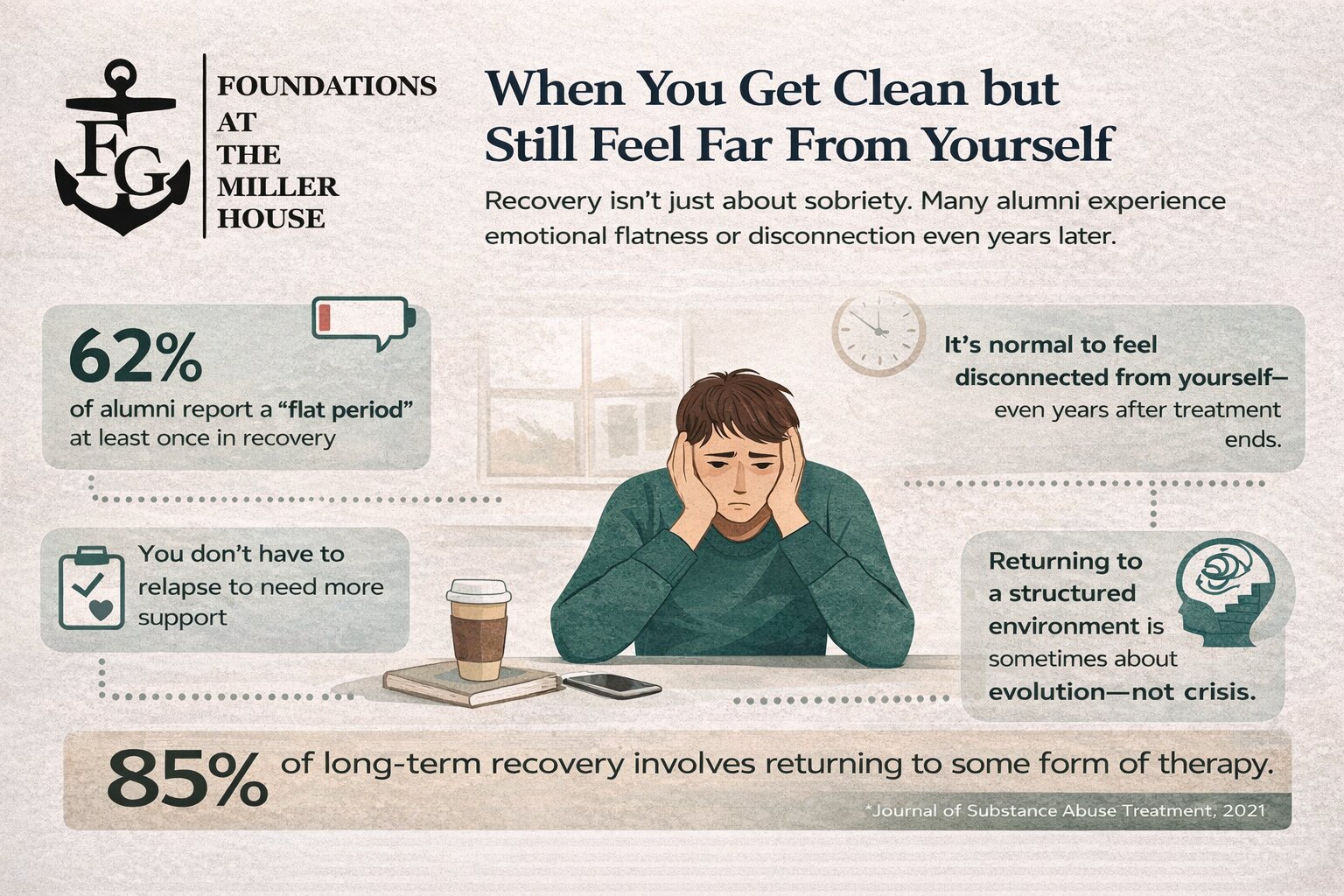
Returning Isn’t Regression
There’s a myth that you only “go back” if something went wrong.
But sometimes you go back because something inside you is asking for more.
More honesty.
More emotional access.
More integration.
When I revisited a higher level of care, I was in a completely different place than my first time.
The first time, I was desperate. Raw. Trying to survive.
The second time, I was sober—but disconnected. Functional—but hungry for meaning.
That changed everything.
The work was quieter. Deeper. Less dramatic. More nuanced.
And I realized something powerful: recovery isn’t a ladder you climb once. It’s more like a spiral staircase. You revisit themes from higher vantage points.
You Don’t Have to Be in Crisis to Deserve Support
This might be the most important part.
You don’t need to relapse.
You don’t need to fall apart.
You don’t need to hit bottom again.
If you feel emotionally distant from your own life, that matters.
If your sobriety feels more like maintenance than growth, that matters.
If you’re functioning—but not fully living—that matters.
Sometimes a structured reset gives you space to hear yourself again. And sometimes the safest place to explore that is in an environment intentionally built for reflection, accountability, and deeper work.
You can explore options through our residential treatment program services if you’re wondering what that next level could look like.
This isn’t about going backward. It’s about continuing.
What Reconnection Actually Looks Like
Reconnection isn’t fireworks.
It’s subtle.
It’s crying at something that wouldn’t have touched you before.
It’s laughing without forcing it.
It’s feeling grief you postponed.
It’s discovering preferences you never explored.
Sometimes it’s uncomfortable. Because numbness, as strange as it sounds, can feel safer than vulnerability.
But vulnerability is where aliveness returns.
I had to learn that stability and depth can coexist. That sobriety isn’t just the absence of chaos—it’s the presence of engagement.
And that sometimes requires stepping back into structured support long after the crisis has passed.
If You’re Reading This and Feeling Seen
Let me speak directly to you for a moment.
You didn’t get sober to become emotionally smaller.
You didn’t fight that hard just to feel neutral about your own life.
If something feels off, you’re allowed to listen to that signal.
It doesn’t mean you failed.
It doesn’t mean your original treatment “didn’t work.”
It doesn’t mean you’re weak.
It might mean you’re ready for the next layer of healing.
And that’s something to respect.
Frequently Asked Questions
Is it normal to feel disconnected years after treatment?
Yes. Very normal. Early recovery focuses heavily on stabilization—removing substances, building routine, repairing immediate damage. Long-term recovery often shifts toward identity, purpose, unresolved trauma, and emotional depth. Feeling disconnected doesn’t mean sobriety isn’t working. It often means you’ve outgrown your current level of support.
Does feeling flat mean I’m about to relapse?
Not automatically. Emotional flatness can increase vulnerability if ignored, but it doesn’t equal relapse. In many cases, it’s a signal—not a prediction. The key difference is whether you’re numbing the feeling or getting curious about it. Seeking deeper support early can actually prevent relapse.
Would returning to live-in treatment mean I failed?
No. Returning for additional care can be a proactive decision. Some alumni re-engage not because they used again, but because they want deeper therapeutic work, trauma processing, or a structured reset. Growth doesn’t invalidate past progress.
How do I know if I need a higher level of care again?
Ask yourself:
- Do I feel emotionally disconnected from myself or others?
- Am I avoiding something deeper that’s starting to surface?
- Has my support system become minimal or surface-level?
- Do I want more depth but don’t know how to access it alone?
If you’re answering “yes” to several of these, exploring structured support may be helpful.
What if I’m scared to admit I’m struggling again?
That fear makes sense. Long-term alumni often feel pressure to be examples of success. Admitting you’re struggling can feel like letting people down.
But honesty is part of recovery. And asking for support before things collapse is strength—not weakness.
Can I reach out even if I’m unsure?
Absolutely. You don’t have to commit to anything to have a conversation. Sometimes clarity comes simply from talking it through with someone who understands the phases of long-term recovery.
If you’re questioning where you are right now, that question itself deserves attention.
You don’t have to live in crisis to deserve depth.
If you’re feeling disconnected, emotionally flat, or unsure what the next chapter of recovery looks like, support is available.
Call 774-252-6966 or visit our residential treatment program services to learn more about our residential treatment program services in Falmouth, MA.