

You thought the last round of treatment would hold.
You let yourself exhale. Maybe you even slept through the night again.
And now the anxiety is back.
As a clinician—and as a parent—I want to start here: if you’re reading this, it’s not because you’re dramatic. It’s because you’re scared. And fear, in this situation, often comes from love and pattern recognition.
You are not overreacting for asking hard questions. Sometimes the most protective thing a parent can do is say, “This feels bigger than what we can manage at home.”
If you’ve started quietly researching options like a residential treatment program in Falmouth, you’re not alone. Many parents begin there—not out of panic, but out of a growing realization that structure and safety may need to look different this time.
Let’s talk through the signs I encourage families to pay attention to.
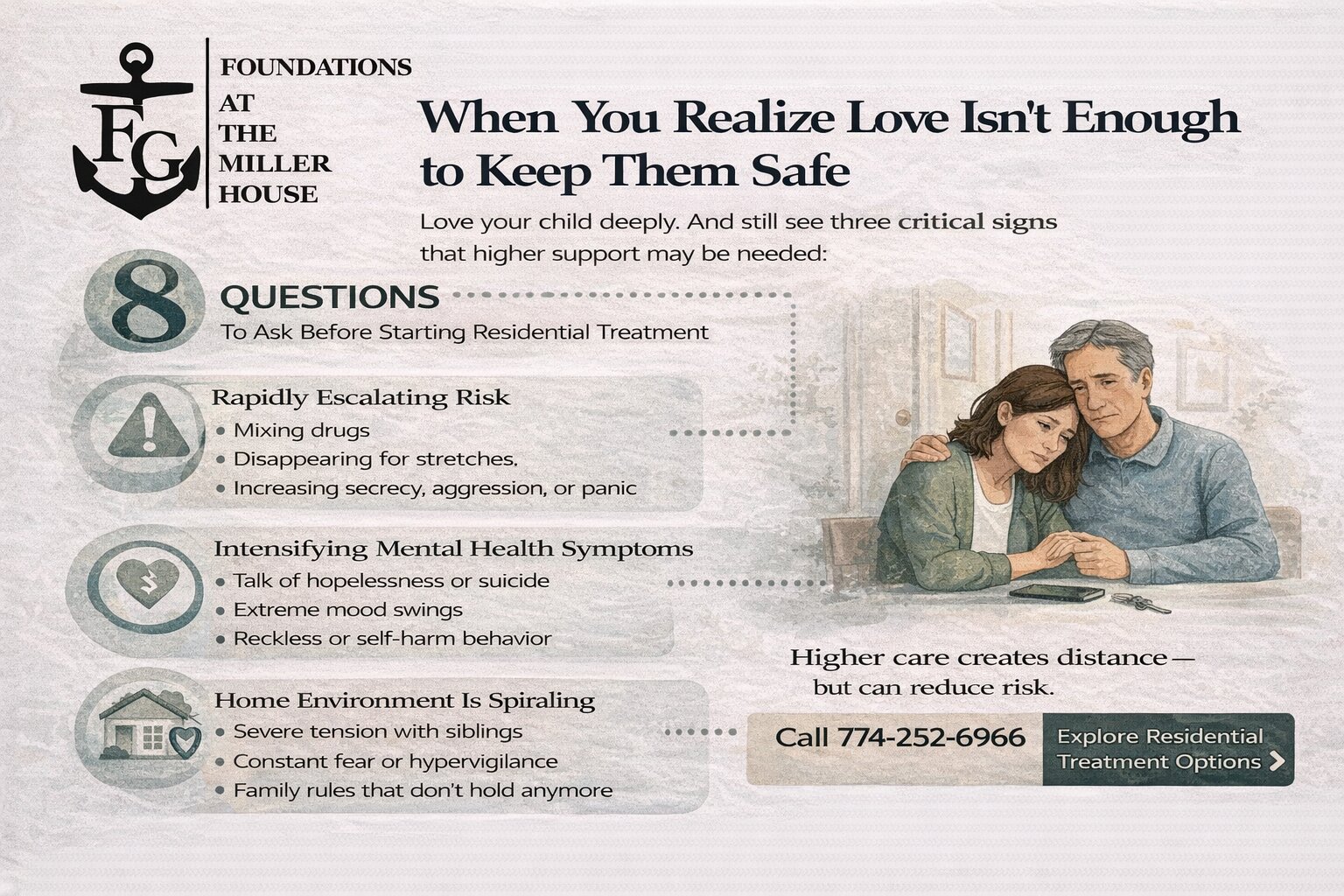
The Relapse Feels Different This Time
Not all relapses are the same.
Some are brief interruptions. A few days. A wake-up call. A quick return to accountability.
But sometimes the shift is sharper. Riskier. Harder to interrupt.
You might notice:
- Faster escalation in substance use
- Mixing substances or trying something new
- Disappearing for long stretches
- A sudden change in peer group
- Increased secrecy layered with defensiveness
There’s often a tone shift, too. The apologies may still come—but they feel rushed, pressured, almost transactional. As if everyone is trying to stabilize the moment instead of the pattern.
When the slope is steep, home may not provide enough containment to stop the slide.
Mental Health Symptoms Are Intensifying
When mental health and substance use collide, things can unravel quickly.
You might see depression deepen into hopelessness.
Anxiety morph into panic or paranoia.
Irritability turn into explosive anger.
Or your child may seem emotionally vacant—flat, withdrawn, unreachable.
Some parents describe it like this: “It’s like they’re here, but they’re not here.”
If you’re noticing talk of worthlessness, reckless behavior, self-harm, or any signs of suicidal thinking, those are not signs to “wait and see.” Those are signals for higher support.
Round-the-clock clinical care can stabilize both substance use and psychiatric symptoms together—something outpatient therapy often isn’t designed to manage during acute episodes.
You’re Living in a Constant State of Hypervigilance
Your nervous system matters in this equation.
Are you:
- Sleeping lightly, waiting for a text?
- Checking bank accounts or car mileage?
- Monitoring social media activity?
- Canceling plans because you’re afraid to leave them alone?
Parents often say, “I feel like I’m on shift 24/7.”
That’s not sustainable.
Love is powerful. But it’s not meant to replace clinical structure. If your home has turned into a crisis response center, that’s not a failure. It’s a signal that the level of need may exceed what a family can provide alone.
Boundaries No Longer Work
You’ve likely tried everything.
Clear rules.
Financial limits.
Curfews.
Drug testing.
Family therapy.
And still, the same patterns return.
Maybe substances are being used inside the house.
Maybe they’re driving impaired.
Maybe younger siblings are exposed to chaos you never imagined bringing into your home.
When every boundary becomes a negotiation—or is simply ignored—the environment stops being therapeutic.
Sometimes the most loving decision isn’t tightening control. It’s changing the environment entirely.
Lower Levels of Care Haven’t Been Enough
Many families try outpatient therapy first. Or structured daytime care. Or multi-day weekly treatment.
And sometimes those work beautifully.
But if attendance drops off, progress stalls, or the intensity of use escalates despite support, it may be time to consider a higher level of care.
A residential treatment program provides physical separation from triggers, peers, and daily stressors. It creates a container where stabilization can actually happen.
This isn’t about punishment. It’s about giving your child a real chance to reset.
Your Gut Is Telling You Something Has Shifted
Parents often second-guess themselves.
What if I’m overreacting?
What if this pushes them further away?
What if they hate me?
Here’s what I’ve observed in my years working with families: when a parent’s concern lingers for weeks and grows instead of shrinking, it’s usually worth listening to.
You know your child’s baseline.
You know their tone.
You know when something feels different.
Trust doesn’t mean panic. It means gathering information and seeking guidance before the next crisis forces your hand.
If you’re looking for support for people in Falmouth, there are options for treatment in Falmouth that offer structured, live-in care during high-risk periods—care designed to stabilize both safety and mental health.
You’re Afraid of the Worst-Case Scenario
This is the part many parents whisper instead of say out loud.
You’re afraid of the phone call.
The overdose.
The arrest.
The accident.
Living in that fear every day is exhausting.
Choosing a residential treatment program can feel extreme. But sometimes it’s actually the preventive step—the decision that reduces the likelihood of those worst-case outcomes.
It’s not about assuming catastrophe. It’s about interrupting patterns before they escalate further.
“But What If They Refuse?”
This is one of the hardest questions.
Young adults legally have autonomy. They can say no.
What matters here is approach. Framing. Timing.
Conversations that begin with accusation often end in shutdown. Conversations that begin with, “We’re scared because we love you,” tend to land differently.
If refusal happens, it doesn’t mean you stop setting boundaries. It may mean adjusting financial support, living arrangements, or expectations to avoid enabling continued use.
This isn’t about control. It’s about aligning your actions with safety.
“Are We Sending Them Away?”
Many parents carry quiet guilt about this.
Let’s reframe it.
Live-in treatment is not exile.
It’s not abandonment.
It’s not giving up.
It’s a medically supported pause.
A place where your child can stabilize without access to substances.
Where sleep can normalize.
Where therapy happens daily.
Where psychiatric support is immediate.
And where you, as parents, can step out of constant crisis mode long enough to breathe.
Sometimes love means stepping back so professionals can step in.
FAQ: Questions Parents Often Ask
How do I know this isn’t just another phase?
Phases tend to stabilize or evolve in predictable ways. Escalation—especially in risk, secrecy, and mental health symptoms—is different. If patterns are intensifying rather than improving, it’s worth exploring higher support.
Will my child feel punished?
That depends on how the conversation is framed. If treatment is presented as “You messed up again,” it may feel punitive. If it’s presented as “We’re scared and want you safe,” it lands differently. Tone matters.
What if they’ve already tried treatment before?
Previous treatment attempts don’t mean future care won’t help. Different environments, staff, and timing can produce very different outcomes. Relapse is common, but it’s not permanent.
How long would they need to stay?
Length of stay varies based on clinical need, progress, and safety. The goal is stabilization and skill-building—not keeping someone longer than necessary.
Can we still be involved?
Family involvement is often encouraged. Healing works best when communication improves on all sides. Parents are part of the recovery ecosystem.
What if we wait?
Waiting is sometimes appropriate. But if risk is increasing—especially with co-occurring mental health concerns—delay can allow patterns to deepen. Early intervention is often more protective than crisis intervention.
Is it normal to feel this conflicted?
Yes. You can love your child deeply and still know that home isn’t enough right now. Those two truths can coexist.
A Final Word for You
I want to say something clearly.
You did not cause this.
You are not weak for considering stronger support.
You are not abandoning your child by seeking structure.
You are responding to risk with care.
If your home has become a place of fear instead of rest…
If your boundaries no longer protect anyone…
If your gut is telling you this is bigger than what you can hold alone…
It may be time to explore a residential treatment program.
And you don’t have to make that decision in isolation.
Call 774-252-6966 or visit our residential treatment program services in Falmouth, MA to learn more about our residential treatment program services in Falmouth, MA.