

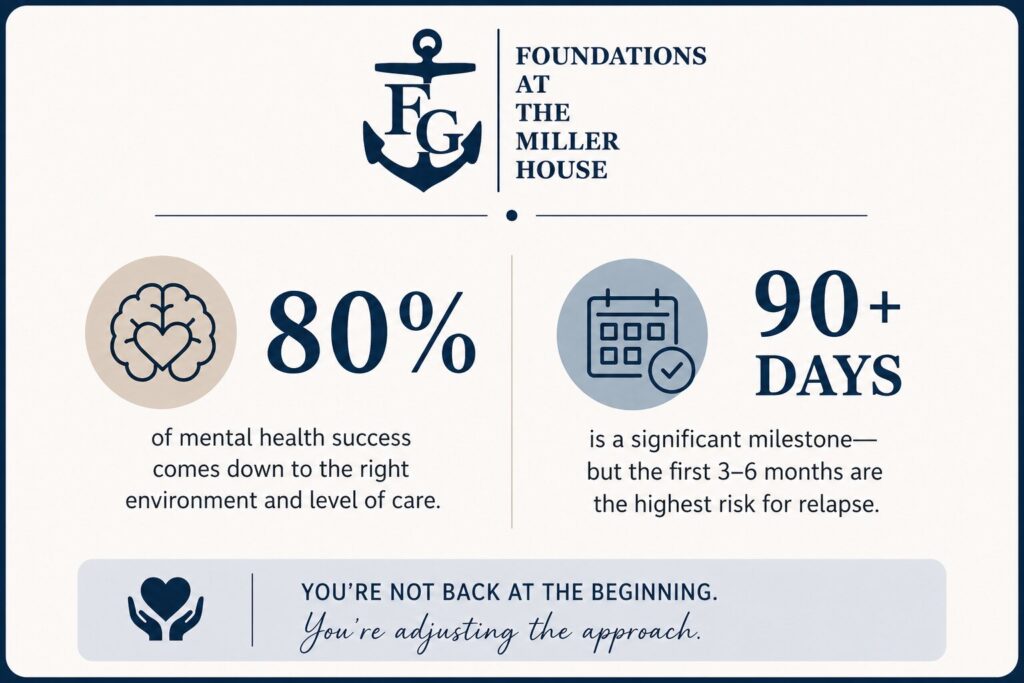
I remember hitting 90 days and thinking, this is it—I’m finally okay.
Not perfect, but steady. Functional. Hopeful in a quiet, believable way.
Then, slowly—not all at once—things started slipping.
Sleep got weird again. My thoughts got louder. That constant low hum of anxiety came back, like background noise I couldn’t turn off. And depression didn’t crash in dramatically… it just settled over everything like fog.
If you’re here, asking yourself what actually helps long term, you’re not overthinking it.
You’re noticing something important.
Somewhere along the way, this question shows up—not as a Google search, but as a feeling:
“Why didn’t what I did before stick?”
That’s where conversations about care levels start to matter. Not in a clinical sense, but in a real-life one—like when you start looking into inpatient vs outpatient mental health and realize… this isn’t just about options.
It’s about what actually holds when things get hard again.
The Part No One Prepares You For After “Doing Well”
There’s this assumption that once you’ve had a stretch of stability, you’ll know how to maintain it forever.
That’s not how it works for a lot of us.
Sometimes, the first phase of getting better is fueled by structure, accountability, and momentum. You’re showing up. You’re learning. You’re doing the work.
But then life slowly resumes its full weight.
Responsibilities come back. Expectations creep in. And the support that once felt like enough starts to feel… thinner.
You might still be doing therapy. Maybe even structured daytime care or multi-day weekly treatment. And still, something doesn’t land the same way anymore.
That doesn’t mean you’ve regressed.
It might mean your needs changed—and your support didn’t.
The Difference Isn’t Just Schedule—It’s How Safe You Feel to Fall Apart
A lot of people frame this decision around logistics:
- Can I take time off work?
- How many days per week can I commit?
- Can I manage this alongside my normal life?
But the deeper question is harder to ask:
Do I actually have space to fall apart—and be supported through it?
Outpatient care often expects you to stay functional while healing. You go to sessions, you talk through things, you learn tools… and then you go back into your life and try to apply them in real time.
And sometimes, that works.
But sometimes, it keeps you in a cycle of holding it together just enough to get by.
Live-in, round-the-clock support changes that equation.
It gives you a contained space where you don’t have to perform stability. Where your job isn’t to manage symptoms quietly—it’s to understand them fully.
That difference matters more than people say out loud.
Why Trying Harder Isn’t Always the Answer
This part can sting a little.
Because if you’re anything like me, your first instinct is to double down. To try harder. To be more consistent. More disciplined.
But effort isn’t always the missing piece.
Sometimes, the environment is.
Outpatient settings can unintentionally reward people who are good at pushing through. You show up composed. You articulate your thoughts. You “do the work.”
But underneath that?
You might still be overwhelmed, disconnected, or barely holding it together.
And no one really sees it—because you’re still functioning.
That’s how people plateau.
Not because they’re not trying, but because they’re still operating inside the same patterns that kept them stuck in the first place.
What Changes When You Step Into Something More Immersive
There’s a moment that happens in more structured, live-in care that’s hard to explain unless you’ve felt it.
At first, it’s uncomfortable.
There’s no distraction. No quick escape back into your routine. No hiding behind productivity or being “fine.”
And then, slowly… something shifts.
You start to notice things you didn’t have space to notice before:
- The exact moment your anxiety spikes—and what triggers it
- The ways depression shows up as avoidance, not just sadness
- The habits you’ve built to cope that aren’t actually helping anymore
You’re not just managing symptoms anymore.
You’re understanding them.
And that understanding? That’s what creates change that actually lasts.
A Truth That’s Hard to Admit
I didn’t think I needed more support.
I told myself I just needed to recommit to what I already knew. Get back into routine. Tighten things up.
But if I’m being honest, I was exhausted.
Not from failing—but from constantly holding myself together.
Stepping into a more immersive level of care felt like admitting defeat at first. Like I should’ve been able to handle it without that level of support.
But it ended up being the first time I wasn’t just surviving my mental health—I was actually working through it.
No rushing.
No pretending.
No pressure to be okay before I was ready.
That’s where things started to stick.
So… What Actually Helps Long Term?
There’s no one-size answer. But there are patterns.
Outpatient care works well when:
- Your symptoms are stable enough to manage between sessions
- Your environment supports your healing
- You’re not constantly slipping back into old patterns
But when things keep looping—when anxiety and depression keep resurfacing in the same ways—it might not be about trying harder.
It might be about going deeper.
And deeper often requires more support, more structure, and more space than outpatient care can provide.
That’s not a step backward.
It’s a more accurate step forward.
You’re Not Starting Over—You’re Adjusting the Approach
Relapse—whether it’s emotional, behavioral, or both—has a way of convincing you that you lost everything.
You didn’t.
You still have insight. Awareness. Experience.
You just learned that what you had before wasn’t enough to carry you through this next layer.
That’s valuable information.
And it can guide you toward something that actually holds this time.
FAQs: The Questions That Usually Come Up (But Don’t Always Get Answered)
Is it normal to need more support after doing well for a while?
Yes. Progress isn’t linear. Many people find that early improvements uncover deeper layers that need more intensive support.
Does choosing live-in care mean outpatient “failed”?
Not at all. It usually means outpatient helped you get as far as it could—and now you need a different level of care for the next phase.
How do I know if I need something more immersive?
If you feel like you’re repeating the same cycles, struggling to apply what you’ve learned, or barely holding things together between sessions—that’s worth paying attention to.
Can outpatient care still be part of long-term recovery?
Absolutely. Many people step down into outpatient care after more immersive treatment. It’s not either/or—it’s about timing and fit.
What if I’m scared to start over again?
That fear makes sense. But this isn’t starting over—it’s continuing, with more support and better alignment for what you actually need right now.
You Don’t Have to White-Knuckle This Again
If you’re feeling that quiet pull—the sense that what you’ve been doing isn’t enough anymore—it’s worth listening to.
You don’t need to prove you can struggle through it alone.
If you’re exploring what deeper, more consistent support could look like, you can learn more about treatment options in Falmouth.
Call (774) 252-6966 or visit our Residential Treatment Program services in Falmouth, MA to learn more about what support can look like when it actually meets you where you are.