

If your adult son has relapsed again and you’re scared he’ll overdose, you’re carrying a fear that many parents struggle to put into words.
You may find yourself checking your phone constantly. You might wake up in the middle of the night and immediately wonder if he’s okay. Every unknown number that appears on your screen can feel like a threat.
Parents often tell us they’re exhausted, but sleep doesn’t come easily. They feel helpless, but they’re constantly trying to help. They know they can’t control their adult child, yet they can’t stop worrying about what could happen next.
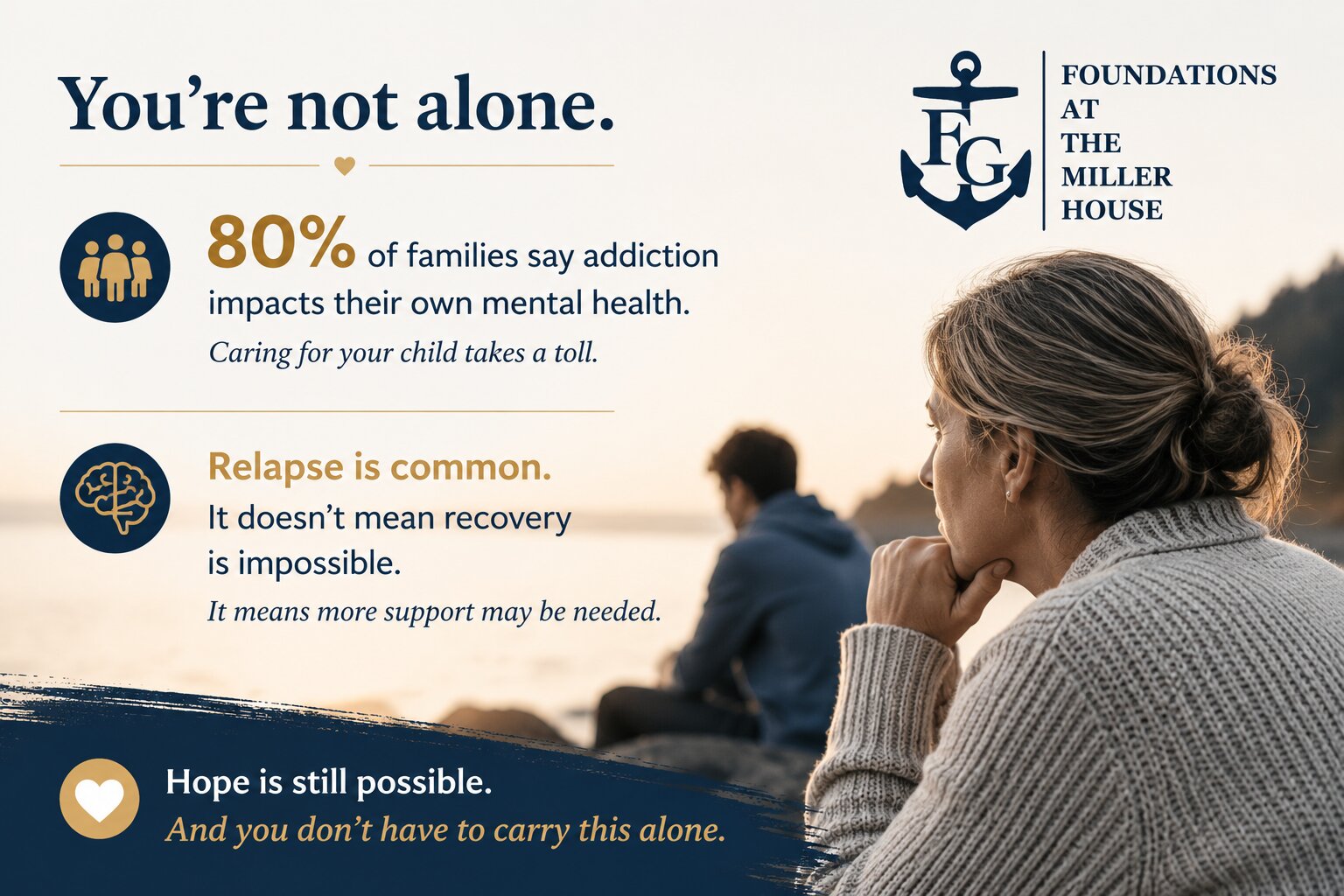
If this sounds familiar, you’re not alone.
As clinicians, we’ve worked with many families facing this exact situation. One of the first things we want parents to understand is that their fear is real, their concern is justified, and their son’s relapse does not mean recovery is impossible.
Many families begin exploring options such as round-the-clock addiction support because they’re looking for a path forward when hope feels fragile.
Your Fear of Overdose Isn’t an Overreaction
Many parents wonder if they’re catastrophizing.
They’re not.
The reality is that relapse can increase overdose risk, especially after a period of sobriety. During abstinence, the body often loses some of its tolerance to substances. If a person returns to using the amount they once used, the consequences can be far more dangerous than expected.
This is one reason families often feel especially frightened after a relapse.
You’re not simply worried about drug use.
You’re worried about losing your child.
That distinction matters.
Parents often minimize their own fear because they don’t want to seem dramatic. Yet carrying this level of anxiety day after day can take a serious emotional and physical toll.
The fear becomes a background noise that never fully turns off.
Why Relapse Feels Different for Parents Than It Does for Everyone Else
When a son relapses, parents often experience two losses at the same time.
The first is the relapse itself.
The second is the loss of hope they had attached to recovery.
Perhaps treatment seemed to be working.
Maybe he had started rebuilding trust.
Maybe family relationships were improving.
Then suddenly it feels as though everything has been erased.
One of the most important things to understand is that relapse does not erase the progress that came before it.
The lessons learned in treatment don’t disappear.
The coping skills aren’t gone forever.
The relationship work wasn’t wasted.
Recovery is often less like climbing a staircase and more like navigating a winding trail. There are setbacks, detours, and difficult stretches that make it feel like you’re moving backward even when progress is still happening beneath the surface.
Separate the Person You Love From the Addiction You’re Fighting
Addiction has a way of becoming the loudest thing in the room.
Parents begin talking only about the substance use.
Every conversation revolves around treatment, money, honesty, consequences, or safety.
Eventually, many families feel like they’ve lost sight of the son they know and love.
This is one of addiction’s hidden costs.
The person becomes harder to see.
Your son may be making decisions that frighten you.
He may be lying, withdrawing, manipulating, or breaking promises.
Those behaviors deserve attention.
But they are not the entirety of who he is.
Maintaining that perspective can help parents communicate more effectively and avoid interactions driven entirely by fear, anger, or desperation.
Focus on Safety Before You Focus on Recovery
When parents panic, they often jump straight to solving the entire problem.
That’s understandable.
But recovery is rarely solved in a single conversation.
A more effective approach is to focus first on immediate safety.
Consider practical steps such as:
- Learning overdose warning signs
- Keeping naloxone available if opioids may be involved
- Knowing local emergency resources
- Maintaining open communication when possible
- Encouraging professional evaluation
- Identifying trusted people who can provide support
Think of it this way.
If someone were trapped in a storm, your first priority wouldn’t be planning their entire future. It would be helping them reach shelter.
Safety comes first.
Everything else follows from there.
Boundaries Are Not the Same Thing as Abandonment
One of the most painful questions parents ask is:
“If I stop rescuing him, am I giving up on him?”
The answer is no.
Supporting an adult child and protecting yourself can happen at the same time.
Healthy boundaries are not punishments.
They’re expressions of reality.
For example:
- You can offer emotional support without providing money.
- You can encourage treatment without forcing it.
- You can answer the phone without accepting abusive behavior.
- You can love your son while refusing to participate in harmful patterns.
Many parents fear that boundaries will damage the relationship.
In reality, consistent boundaries often reduce chaos and create more honest interactions over time.
Think of boundaries as guardrails along a mountain road. They don’t stop someone from driving, but they can help prevent a devastating fall.
Understand the Role Mental Health May Be Playing
Sometimes families focus entirely on the substance use and miss what may be happening underneath it.
Many individuals struggling with addiction are also dealing with anxiety, depression, trauma, unresolved grief, or other mental health concerns.
This becomes particularly important after repeated relapses.
If your son appears hopeless, emotionally withdrawn, unusually anxious, or overwhelmed, there may be more happening than substance use alone.
When mental health and substance use collide, recovery often becomes more complicated.
It also becomes more important to seek comprehensive care that addresses the whole person rather than only the symptoms that are easiest to see.
This is often where conversations about drug relapse help begin to shift toward understanding the deeper challenges driving the cycle.
Don’t Let Addiction Take Two Lives
Parents rarely expect addiction to affect them the way it does.
Over time, many become consumed by fear.
They stop socializing.
They stop sleeping.
They lose interest in hobbies.
They neglect their own medical care.
They begin measuring every day by whether their child seems okay.
This is understandable.
It’s also unsustainable.
One mother told us, “I felt like I was drowning while trying to keep my son from drowning.”
That image captures what many parents experience.
Your wellbeing matters.
Not because your pain is equal to your son’s struggle, but because you cannot pour from an empty cup forever.
Seeking support for yourself is not selfish.
It’s part of surviving this experience.
Hope Doesn’t Require Certainty
Many parents believe they must choose between realism and hope.
You don’t.
Hope isn’t pretending relapse isn’t serious.
Hope isn’t ignoring overdose risk.
Hope isn’t convincing yourself everything will work out exactly as planned.
Hope is simply refusing to believe that today’s circumstances are the final verdict on your son’s life.
We’ve seen people return from multiple relapses.
We’ve seen families rebuild trust that seemed impossible to repair.
We’ve seen parents who spent years terrified eventually watch their children build meaningful recovery.
None of those outcomes were guaranteed.
But they were possible.
And possibility matters.
Especially on the days when fear feels louder than everything else.
Frequently Asked Questions
What should I do if I think my son is at risk of overdosing?
If you believe your son is experiencing an overdose, call emergency services immediately. If naloxone is available and opioid use is suspected, administer it according to instructions while waiting for emergency responders.
Is relapse a sign that treatment failed?
Not necessarily. Relapse can indicate that additional support, different treatment approaches, or ongoing care may be needed. Many people who achieve long-term recovery have experienced one or more relapses along the way.
Should I give my son money if he says he needs help?
This depends on the situation, but many families choose to provide support in ways that reduce risk. For example, paying directly for food, transportation, or treatment services rather than providing cash.
How can I talk to my son without pushing him away?
Try focusing on concern rather than criticism. Statements such as “I’m worried about you” often create more productive conversations than accusations or ultimatums.
Can I force my adult son into treatment?
Laws vary by state and circumstances. In most situations, adults must choose treatment voluntarily unless there is a significant safety concern that meets legal criteria for intervention.
How do I know if he needs a higher level of care?
Repeated relapses, overdose risk, worsening mental health symptoms, inability to maintain daily responsibilities, or dangerous substance use patterns may indicate a need for more intensive support.
How do I take care of myself while helping him?
Consider attending support groups, seeking counseling, maintaining your own health appointments, and staying connected to trusted friends and family. Supporting someone with addiction is emotionally demanding, and you deserve support too.
If you’re watching your son struggle and feeling terrified about what could happen next, remember this: you do not have to carry that fear alone. Help is available, and recovery remains possible even after relapse.
Call (774) 252-6966 or visit our residential treatment program services to learn more about our residential treatment program services.