

You already know something isn’t right.
Not in a vague, “maybe I should look into this someday” way—but in a quiet, persistent knowing that follows you through the day.
It shows up in the moments you cancel plans.
In the hesitation before opening your front door.
In the way your body reacts before your mind can even explain why.
And if you’ve found yourself searching for something like round-the-clock support, a part of you has already crossed a line internally.
You’re not just wondering anymore.
You’re recognizing.
You’re Past the “Maybe It’ll Go Away” Stage
There’s a phase where anxiety still feels temporary.
Like something you can outwait or outwork.
You try to adjust:
- Sleeping more (or less)
- Cutting out stress where you can
- Talking yourself through it
But over time, something shifts.
The anxiety stops feeling like a moment—and starts feeling like a pattern.
You notice:
- The same fears repeating daily
- The same avoidance behaviors getting stronger
- The same exhaustion no matter how much you rest
At this point, it’s not about figuring out if something is wrong.
It’s about deciding what to do with what you already know.
The Hesitation Isn’t About Weakness—It’s About Fear
If you already know you need more support, the question becomes:
What’s stopping you?
It’s rarely laziness.
It’s rarely denial.
It’s fear—but not the kind people talk about openly.
It sounds like:
- “What if I go and I can’t handle it?”
- “What if I lose control in front of people?”
- “What if I feel worse before I feel better?”
And maybe the biggest one:
“What if this is real—and I can’t just push through it anymore?”
That thought can feel like a loss of identity. Especially if you’ve always been the one who keeps it together.
Anxiety Quietly Reshapes Your Life
Anxiety doesn’t always take things away all at once.
It negotiates.
Just one small adjustment at a time:
- “Skip this event—you’re tired.”
- “Stay home today—it’s safer.”
- “Don’t answer that call—you’ll deal with it later.”
At first, it feels like self-protection.
But slowly, those choices start building a smaller life.
A life where:
- Your comfort zone shrinks
- Your confidence fades
- Your independence feels fragile
And the hardest part?
You can see it happening.
That awareness can feel frustrating, even embarrassing. But it’s actually a sign of clarity—not failure.
Why Staying Feels Easier (Even If It Hurts)
There’s a reason you haven’t made the leap yet.
Even if your current situation feels overwhelming, it’s still familiar.
You know how to navigate it—even if it’s exhausting.
Stepping into something like live-in care means:
- New routines
- New people
- Letting go of control (at least a little)
That’s a lot for a nervous system that’s already overwhelmed.
So your brain does what it’s designed to do—it keeps you where things feel predictable.
Even if predictable isn’t working anymore.
You Don’t Need to Be Fully Ready
This is one of the biggest misconceptions about getting help.
People think they need to reach a certain level of readiness before taking action.
But most people who begin structured, immersive care don’t feel ready at all.
They feel:
- Scared
- Uncertain
- Mentally and emotionally drained
Readiness doesn’t come first.
Action does.
Sometimes the decision happens quietly—without confidence, without clarity—just a small moment where you decide,
“I can’t keep doing this the same way.”
And that’s enough.
What Real Support Actually Looks Like
If you’ve never experienced a structured environment before, it’s easy to imagine the worst.
But real, effective support isn’t about taking control away from you.
It’s about giving you a stable foundation when things feel unsteady.
That can look like:
- Consistent daily structure
- Professional guidance that doesn’t judge or rush you
- A space where you don’t have to pretend you’re okay
- Time to reset your nervous system without constant pressure
Think of it less like being “placed somewhere”
and more like being held in a space where healing is possible again.
You’re Not the Only One Who’s Reached This Point
Severe anxiety has a way of isolating you.
It tells you:
- “Other people don’t feel this stuck.”
- “You should be able to handle this.”
- “You’re the exception.”
But that’s not true.
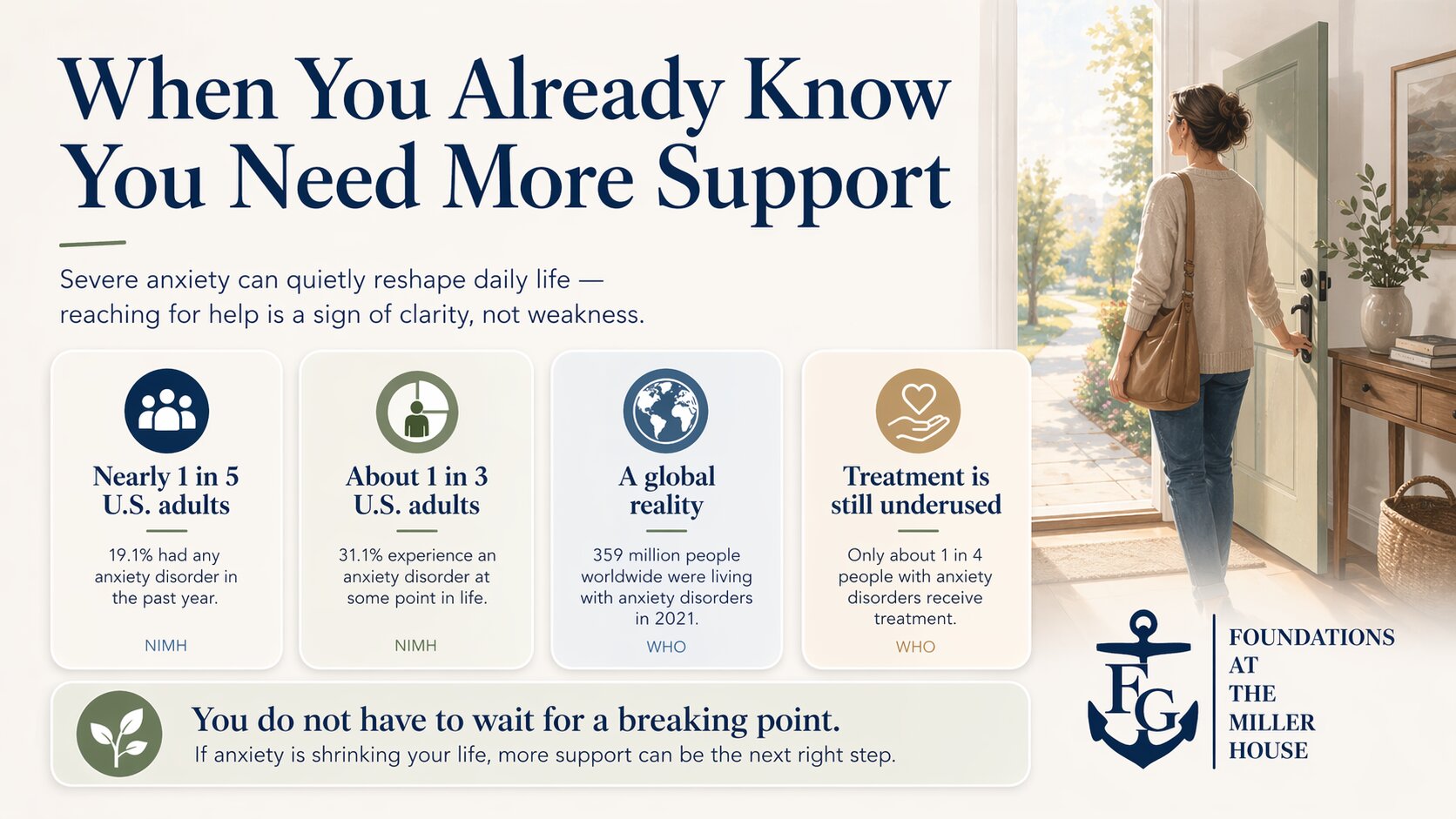
Many people reach a point where anxiety starts controlling their ability to function—where leaving the house, interacting socially, or even managing daily responsibilities feels overwhelming.
Seeking severe anxiety help isn’t a last resort—it’s a turning point.
It’s what people do when they realize they deserve more than just coping.
There’s Still a Version of You That Feels Free
Right now, your life might feel narrowed down to what feels manageable.
But that’s not your full range.
There’s still a version of you that:
- Moves through the day without constant anticipation
- Makes decisions without fear driving them
- Feels present instead of bracing for the next wave
That version didn’t disappear.
It adapted. It protected. It pulled back.
And with the right support, it can expand again.
Not overnight.
Not perfectly.
But steadily.
You’re Allowed to Take This Seriously
You don’t have to hit a breaking point to deserve help.
You don’t have to prove how bad it’s gotten.
If your life feels smaller than it used to—and you know something needs to change—that’s enough.
Taking that seriously isn’t dramatic.
It’s honest.
Frequently Asked Questions
Do I really need something this intensive?
If your anxiety is significantly limiting your daily life—especially your ability to leave home, function socially, or feel safe—it may be worth exploring a higher level of care. It doesn’t mean you’re “too far gone.” It means you’re ready for stronger support.
What if I’m scared to be away from home?
That fear is incredibly common. Many people entering live-in care feel the same way at first. Good programs understand this and help you adjust gradually, not all at once.
Will I lose my independence?
The goal of structured care isn’t to take away independence—it’s to help you rebuild it in a more stable, sustainable way.
What if treatment doesn’t work for me?
That concern makes sense, especially if you’ve tried other approaches before. But not all support is the same. Sometimes the level of care—not just the effort—is what makes the difference.
How long does something like this last?
Length of stay can vary depending on your needs, but the focus is always on helping you build real, lasting stability—not rushing the process.
Is it normal to wait this long before getting help?
Yes. Many people try to manage things on their own for a long time before reaching out. Waiting doesn’t mean you’ve failed—it means you’ve been trying.
If you’re at the point where you already know you need more support, you don’t have to keep carrying that alone.
Call (774) 252-6966 or visit our residential treatment program services in your area to learn more about what taking the next step could look like.