

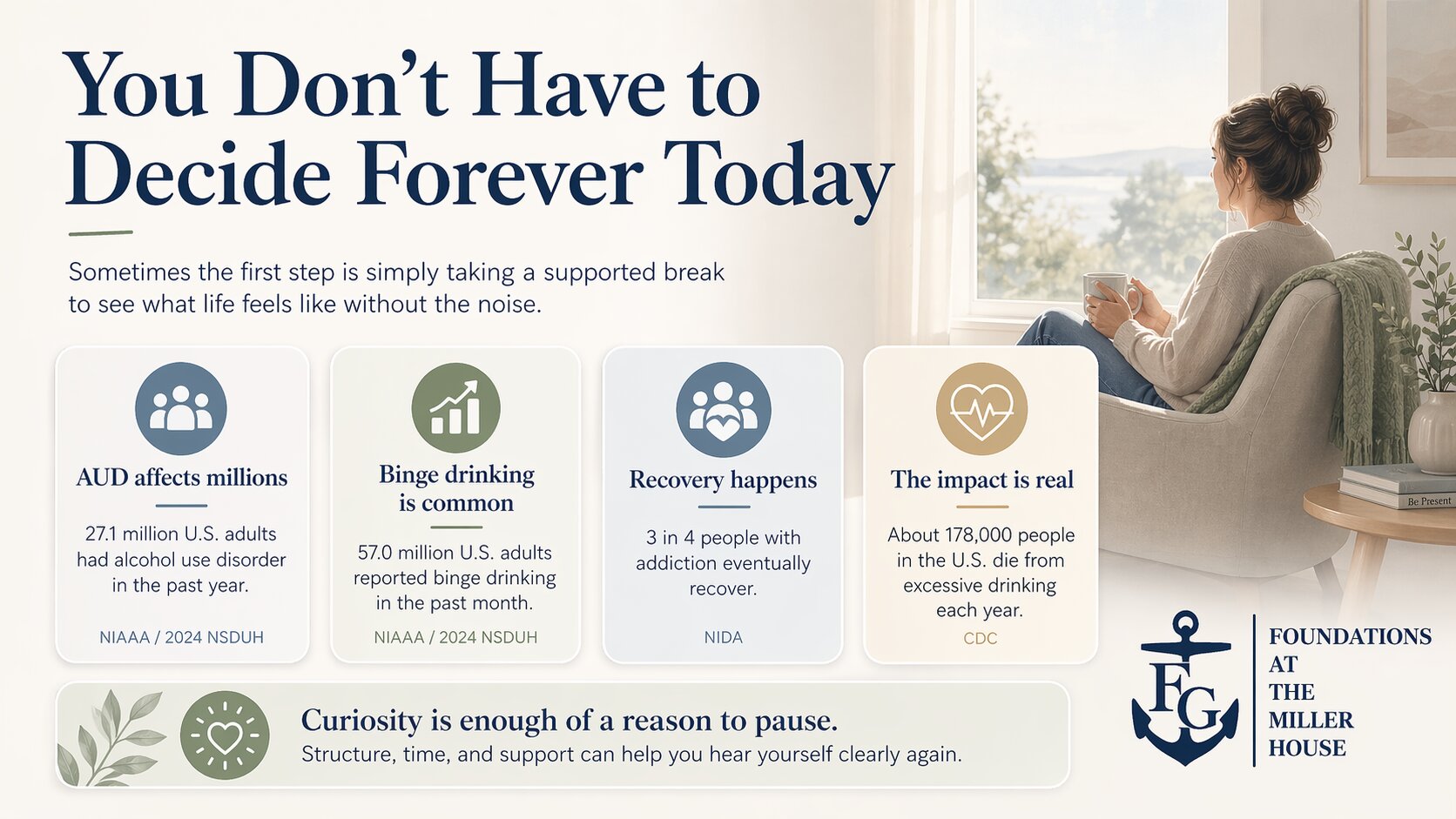
You don’t have to decide the rest of your life right now.
Sometimes, all you’re really asking is: What would it feel like to just stop for a while?
If that question has brought you here—maybe even toward something like round-the-clock support—that’s not overthinking. That’s awareness starting to speak a little louder.
And it deserves to be heard.
Step 1: Let Curiosity Be Enough of a Reason
You don’t need a rock-bottom moment.
You don’t need a dramatic story.
Sometimes it’s just:
- Feeling off more often than not
- Wondering why you rely on it to relax or sleep
- Not liking how you feel the next day—but repeating it anyway
- Questioning if this is really helping anymore
That’s not failure. That’s insight.
Being sober curious doesn’t mean something is “wrong” with you.
It means you’re paying attention to what’s working—and what isn’t.
And honestly? That’s where real change usually begins.
Step 2: Stop Trying to Solve This Alone in Your Head
If you’ve tried to “cut back” before, you already know how that goes.
You make a plan:
- “Just weekends”
- “Just socially”
- “Just one or two”
Then life happens.
Stress hits. Emotions spike. The rules bend.
And suddenly you’re back where you started—only now with more frustration.
This isn’t about discipline.
It’s about the fact that once something becomes your go-to relief, your brain will keep choosing it.
That’s why stepping into a structured environment can feel different.
It removes the constant mental tug-of-war.
No negotiating. No justifying. No “maybe tonight is fine.”
Just space to breathe without the noise.
Step 3: Understand Why a Real Break Feels So Hard
Stopping sounds simple—until you actually try to do it.
Because what shows up after you stop isn’t always easy:
- Restlessness
- Anxiety
- Sleep disruption
- Emotions you’ve been buffering
That’s the part most people don’t expect.
It’s not just about removing something.
It’s about meeting everything that was underneath it.
And doing that alone can feel overwhelming.
In a live-in setting, you’re not left to figure that out by yourself.
You’re supported through it—moment by moment, day by day.
That changes everything.
Step 4: Let Structure Do the Heavy Lifting
One of the biggest reliefs people experience in a structured setting is this:
You don’t have to manage everything at once.
There’s a rhythm to your day:
- Set wake-up times
- Regular meals
- Support sessions
- Time to rest and reset
At first, it might feel unfamiliar.
But then something shifts.
Your mind—used to constant decision-making and emotional noise—starts to quiet down.
Structure becomes less about rules… and more about relief.
Like someone finally turning down the volume on everything that’s been overwhelming you.
Step 5: Give Yourself Enough Time to Actually Reset
A quick break can show you discomfort.
A real break shows you change.
This is where conversations around inpatient treatment length of stay come into play—not as a restriction, but as an opportunity.
Because your body and mind need time to:
- Stabilize after stopping
- Regulate your nervous system
- Rebuild natural sleep and energy patterns
- Experience life without the constant influence of substances
A few days might feel like survival.
A few weeks can feel like clarity.
And clarity is where real decisions start to form.
Step 6: Notice What Starts to Come Back
This part surprises people.
Not because it’s dramatic—but because it’s subtle.
You might notice:
- Your thoughts feel less crowded
- Your reactions slow down
- Your energy becomes more predictable
- You feel moments of calm that don’t need to be created artificially
It’s not instant.
But it’s real.
And maybe the biggest shift is this:
You stop wondering who you are without it—
because you start experiencing it.
Step 7: Redefine What “Control” Actually Means
A lot of people stay stuck because they think stepping into support means losing control.
But here’s the flip side:
If something feels hard to stop, is that really control?
Taking a break in a supported environment isn’t giving something up.
It’s gaining the ability to choose again.
To decide from a clear place—not a reactive one.
That’s a different kind of control. A stronger one.
Step 8: Decide What Comes Next—Without Pressure
You don’t have to leave with a lifelong commitment.
That’s the myth that keeps people from starting.
Instead, you leave with:
- Real data about how you feel without it
- A clearer understanding of your patterns
- Support in deciding what actually works for you
Maybe you continue forward without substances.
Maybe you redefine your relationship with them.
But whatever you decide—it’s informed.
Not reactive. Not forced.
And that makes a difference.
You’re Allowed to Pause Without Explaining It to Anyone
Not everything has to be a crisis to matter.
Sometimes it’s just a quiet realization:
“I don’t feel like myself anymore.”
And instead of pushing through, numbing out, or waiting for things to get worse…
you choose to pause.
That’s not dramatic.
That’s self-awareness turning into action.
Frequently Asked Questions
Do I have to be “addicted” to take a break in a structured setting?
No. Many people enter live-in care because they want clarity, not because they identify with a label. You’re allowed to explore your relationship with substances without defining it permanently.
What if I’m not sure I want to quit forever?
You don’t have to decide that right now. The goal is to step away long enough to understand how you actually feel without it—then decide from there.
Will it feel overwhelming at first?
It can feel unfamiliar in the beginning. But most people adjust faster than they expect, especially with the right support and structure in place.
What happens during the day?
Your day typically includes a mix of structured support, personal reflection time, and space to reset physically and mentally. The goal is balance—not pressure.
How long do people usually stay?
It depends on individual needs, but the focus is on giving you enough time to experience real change—not just a temporary pause.
What if I try this and realize I don’t need it?
That’s still valuable. You’ll leave with clarity and insight—something most people don’t get from trying to figure it out alone.
Is it normal to feel unsure about taking this step?
Completely. Most people feel uncertain before they start. Taking action doesn’t require certainty—it just requires a willingness to try something different.
If you’re ready to step out of the cycle—even just to see what’s on the other side—you don’t have to do it alone.
Call (774) 252-6966 or visit our residential treatment program services in your area to learn more about what a supported break could look like.