
It’s one thing to watch someone you love struggle with addiction. It’s another to realize they’re not just using—they’re deeply, persistently depressed.
Maybe treatment helped before. Maybe it didn’t. But now the relapse came quietly, and so did the shutdown: the sleeping all day, the disappearing, the not-caring-about-anything energy. And once again, you’re left staring at closed bedroom doors and wondering what went wrong.
At Foundations at the Miller House, we often meet families right at this moment—where substance use and depression have blurred together, and hope feels threadbare. And when that moment comes, getting the right kind of help can make all the difference.
If addiction and depression are both pulling you under, a live-in setting can provide the stability and relief you haven’t been able to find alone.
Call 774-252-6966 or explore our men’s residential program in Falmouth, MA. We’re here to listen, not to lecture.
Recovery Doesn’t Follow the “Fix One, Then the Other” Formula
It’s natural to think in steps: first we deal with the substance use, then we look at the depression. Or vice versa. But depression and addiction aren’t that neat.
The reality is that they feed off each other. Depression can sap motivation to stay sober. Substance use can deepen hopelessness. When both are active, meaningful recovery often requires a setting where someone can receive round-the-clock support, not just for their behavior, but for their emotional paralysis.
You Can’t Coach Someone out of Despair
When someone you love is spiraling, it’s instinctive to problem-solve. Offer advice. Try boundaries. Plead for change. But once depression has taken hold, even logic often can’t reach it.
What looks like defiance might actually be despair. And sometimes, the only way forward is through a full stop: a change of environment, a pause in the chaos, and a setting that’s built for healing both mind and body.
“High-Functioning” Doesn’t Mean “Doing Fine”
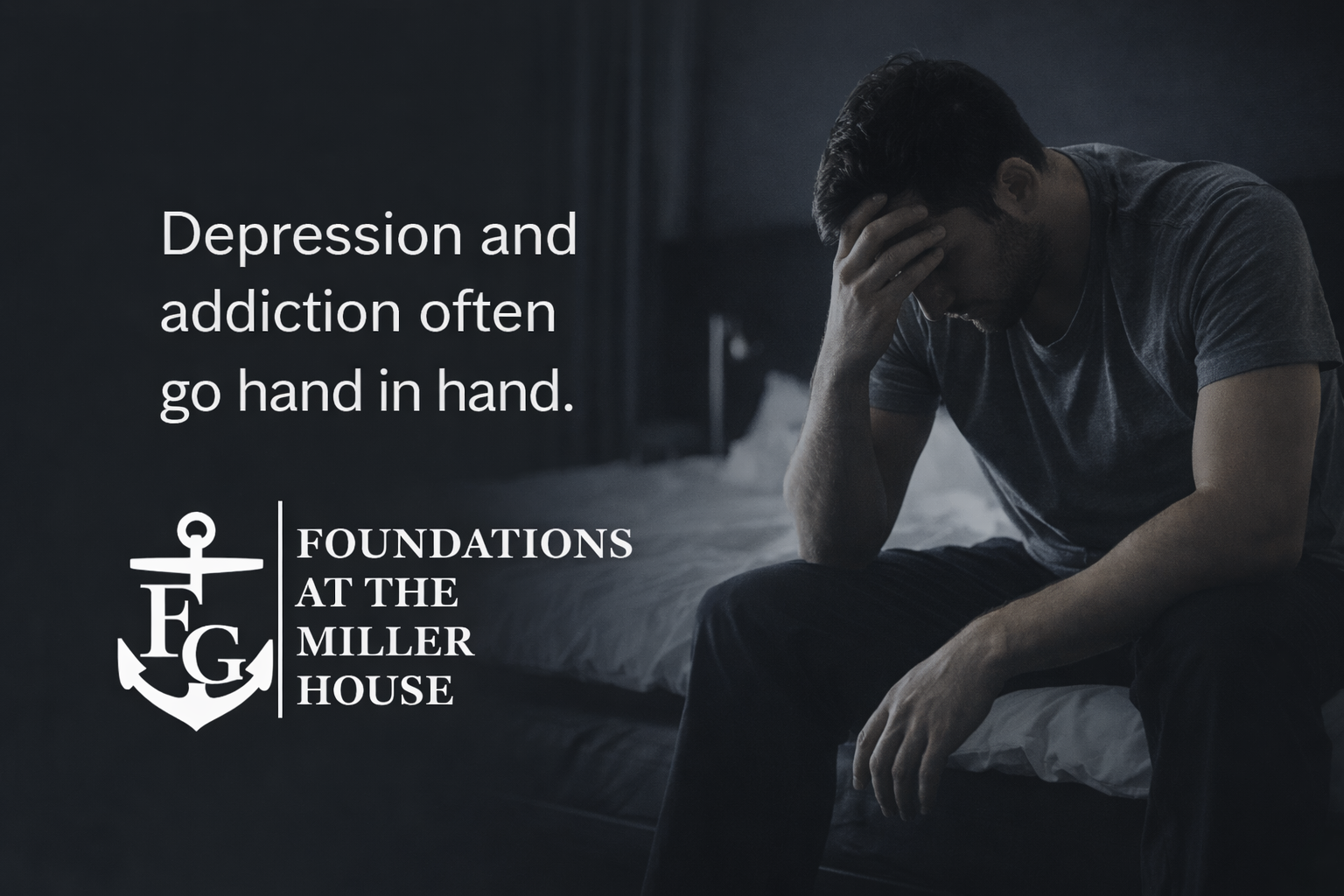
Some people with depression and addiction still show up to work, return your texts, maybe even smile in public. That doesn’t mean they’re okay.
Many of the men at Foundations at the Miller House arrived having masked their pain for years. The drinking didn’t always look out of control. The depression didn’t always look dramatic. But underneath? There was numbness. Or emptiness. Or a belief that nothing could actually get better.
That belief can quietly unravel someone’s motivation to keep trying.
Relapse Can Be Part of the Process
One of the hardest truths to hold: relapse often has nothing to do with effort. Someone can genuinely want to stay sober and still slip.
Without the right kind of care—especially care that addresses co-occurring depression—motivation alone often isn’t enough. The brain chemistry, the emotional backlog, the isolation… these don’t resolve just because someone “wants it.”
Sometimes, relapse is the nervous system crying out: “I’m still not okay.” And that doesn’t mean failure. It may simply mean more help is needed.
Real Recovery Means Addressing Both
Talk therapy might help with depression, but it can’t always hold someone in active addiction. Detox might stabilize the body, but it doesn’t heal the heaviness underneath.
That’s where live-in treatment becomes more than useful—it becomes necessary. A residential program like the one at Foundations at the Miller House is designed to hold both parts: the substance use and the shut-down. The stuckness and the shame. It’s not a magic fix, but it is a place to finally stop hiding.
Your Grief Doesn’t Mean You Failed
If you’re reading this, you’ve probably already lost sleep, money, peace of mind. You’ve done the research. You’ve tried everything you know. And still, it hurts.
That grief? It doesn’t mean you did something wrong. It means you’ve been carrying something heavy in a world that doesn’t always make healing easy. That love is still powerful—and it still matters.
Worried About the Cost of Residential Care?
It’s a common concern—especially when things haven’t hit a crisis point. You might wonder, “Does insurance even cover something like this?”
At Foundations at the Miller House, we accept both private insurance and MassHealth (Medicaid). You don’t need to wait for an emergency or a hospital referral to access meaningful, round-the-clock care.
If you’re unsure what your plan includes, we’ll walk you through it. No pressure. Just clear, honest help so you can understand your options.
Call 774-252-6966 or start the insurance verification process. We’ll help you take it one step at a time.
You’re Allowed to Hope Again
There is help for men who feel stuck in the cycle of addiction and depression. You don’t have to wait for a crisis or hit rock bottom to reach for something better.
If things feel heavy—if motivation is gone, and nothing seems to work—a live-in setting can provide the structure, calm, and clarity that’s been missing. At Foundations at the Miller House, we offer residential care for men who need more than just another chance. We meet you where you are—with compassion, not judgment.
Call 774-252-6966 or explore our men’s residential program in Falmouth, MA. We’re here to help you take the next step, gently.