

You already know something has to change.
Maybe you’ve tried to manage it on your own. Maybe you’ve promised people you’d cut back. Maybe you’ve scared yourself more than once.
And now you’re here—looking at options, wondering what actually happens when you enter a residential treatment program.
If you’re honest, the fear isn’t just about detox or therapy.
It’s deeper than that.
It’s:
What if I can’t do this?
What if I can—and I hate it?
What if I lose myself?
Let’s walk through what really changes. And what doesn’t.
The Chaos Slows Down
Before treatment, most people live in a kind of mental noise.
There’s the bargaining. The guilt. The planning. The hiding. The managing. The recovering. Then doing it again.
It’s exhausting.
When you enter live-in care, the external environment shifts immediately. You’re no longer navigating the same streets, the same contacts, the same routines that kept the cycle going.
That physical separation matters more than people realize.
The nervous system, which has likely been stuck in fight-or-flight mode, finally gets a chance to downshift.
You might not feel peaceful right away. But you may feel something unfamiliar:
Space.
And space is where healing begins.
Your Days Have Structure (And That’s a Good Thing)
Right now, your days might feel unpredictable. Or numb. Or consumed by planning around substance use.
In treatment, your day has a rhythm:
- Wake up at the same time
- Shared meals
- Individual therapy
- Group sessions
- Educational workshops
- Movement or mindfulness
- Evening reflection
At first, structure can feel rigid. Especially if you’re used to autonomy.
But structure isn’t punishment. It’s stabilization.
When your internal world feels chaotic, external steadiness becomes an anchor.
Think of it like scaffolding around a building under repair. No one confuses scaffolding with the building itself. It’s temporary support while something stronger is rebuilt.
You’re No Longer Doing This Alone
Addiction isolates.
Even if you’re surrounded by people, there’s often a private loneliness that comes with it. A sense that no one truly understands the thoughts you don’t say out loud.
Inside a live-in setting, you meet people who get it without explanation.
You don’t have to justify why you’re there.
You don’t have to minimize your story.
You don’t have to pretend you’re “not that bad.”
That shared understanding creates something powerful: safety.
One of our alumni once said:
“I thought everyone would see the worst parts of me. Instead, they saw the parts I forgot were still there.”
– Foundations Group Miller Alumni
Connection doesn’t erase struggle. But it makes it survivable.
The Work Is Emotional — Not Punitive
Many first-time treatment seekers quietly fear that entering care is a form of consequence.
Like you’re being sent somewhere because you failed.
That’s not how we see it.
A residential setting isn’t about punishment. It’s about understanding.
What was the substance doing for you?
What pain did it help you avoid?
What trauma never got processed?
What anxiety was never named?
When mental health and substance use collide, the solution isn’t shame. It’s clarity and support.
Therapy sessions aren’t lectures. They’re conversations.
You’ll explore patterns, coping skills, boundaries, relationships, and emotional regulation. Not to dissect you—but to equip you.
Recovery isn’t about being told who you are.
It’s about rediscovering who you’ve always been underneath survival mode.
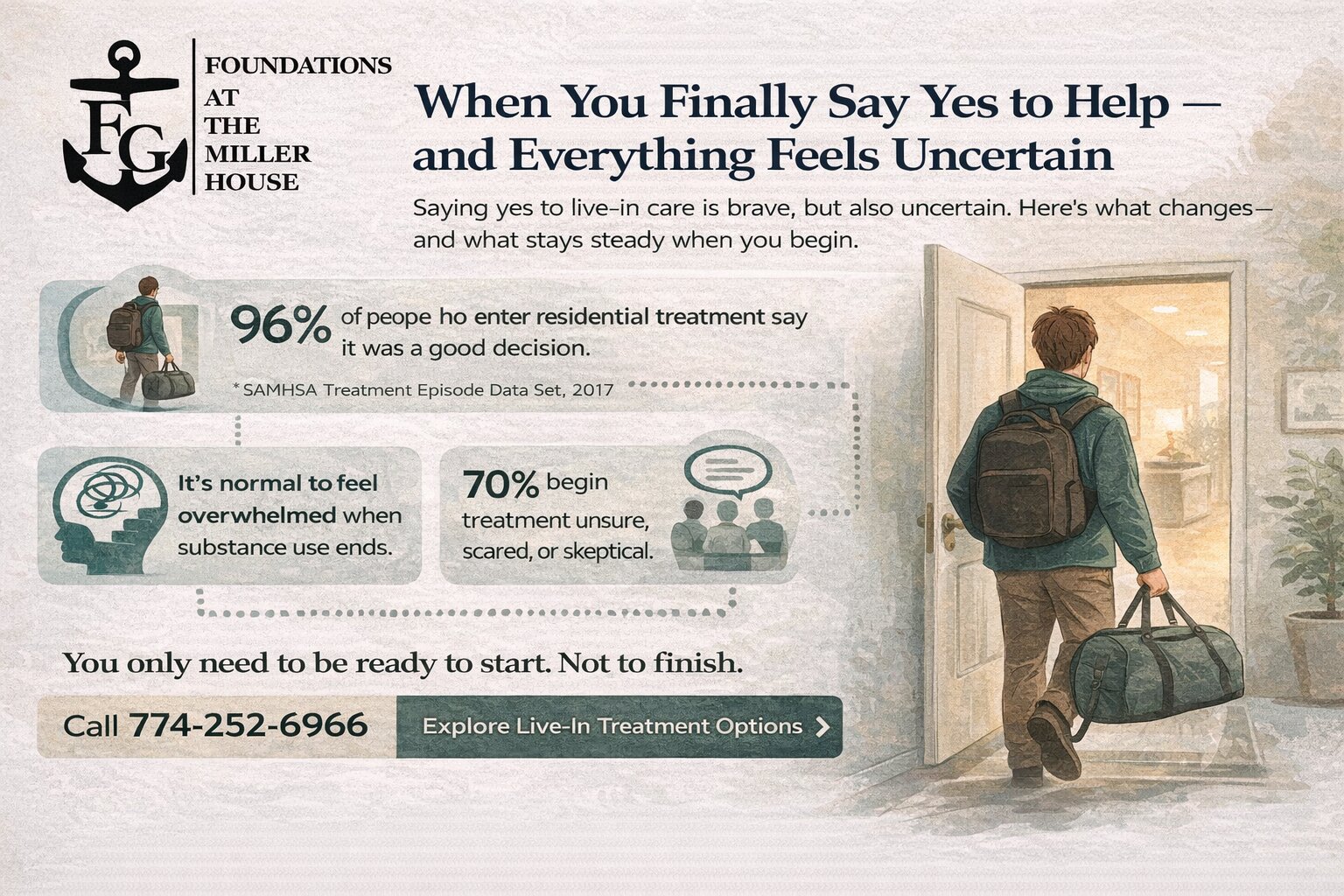
You Might Feel Worse Before You Feel Better
This part deserves honesty.
When substances leave your system, emotions don’t vanish. They often rise.
You may feel:
- Irritable
- Grief-stricken
- Anxious
- Angry
- Deeply tired
- Suddenly vulnerable
This doesn’t mean treatment is failing.
It means your nervous system is recalibrating.
It means you’re feeling again.
And unlike before, you won’t be alone with it.
Clinical staff are there to help you regulate. Peers are there to normalize what you’re experiencing. You’ll learn tools—not just to survive intense emotions, but to move through them.
Feeling isn’t a setback.
It’s a sign of healing.
Your Identity Expands — It Doesn’t Shrink
One of the biggest unspoken fears is this:
If I get sober, who will I be?
For some people, substances have been tied to creativity, confidence, social ease, or coping for years.
Letting go can feel like erasing a part of yourself.
But what many clients discover is the opposite.
They don’t become smaller.
They become clearer.
Humor returns without the haze.
Conversations feel more present.
Sleep deepens.
Emotions stabilize.
You’re not losing your personality.
You’re separating it from the substance.
And that difference matters.
Accountability Feels Different Inside Treatment
Outside of treatment, accountability often comes through consequences.
Inside treatment, accountability looks like support.
If you’re struggling, someone checks in.
If you withdraw, someone notices.
If you want to give up, someone helps you stay five more minutes.
That steady presence builds resilience.
You begin to internalize a different voice—one that says, Stay. You can handle this. You don’t have to run.
Over time, that voice becomes yours.
Family Dynamics Start to Shift
Entering live-in care often changes more than just your routine.
It shifts your relationships.
Family members may feel relief, fear, guilt, or hope—all at once.
Treatment creates boundaries that may not have existed before. Space for healthier communication. Opportunities for family sessions where repair can begin.
It’s not about blaming anyone.
It’s about untangling patterns that kept everyone stuck.
Healing doesn’t just happen individually. It ripples outward.
What Stays the Same
In the middle of all these changes, something important remains steady:
Your worth.
You are not defined by how long you used.
You are not defined by relapse.
You are not defined by the worst moment of your life.
Treatment doesn’t take away your intelligence, your humor, your depth, your history, or your potential.
It creates a protected space where those parts can breathe again.
What If You’re Still Scared?
Good. Fear doesn’t disqualify you from recovery.
Most people who enter treatment are afraid.
Afraid it won’t work.
Afraid it will.
Afraid of judgment.
Afraid of change.
Courage isn’t the absence of fear. It’s moving forward while fear rides in the passenger seat.
You don’t have to feel 100% ready.
You just have to be willing to begin.
Frequently Asked Questions
How long will I stay?
Length of stay varies based on individual needs, clinical recommendations, and progress. Some individuals benefit from shorter stabilization periods, while others need extended time for deeper therapeutic work.
This isn’t one-size-fits-all. Your care plan is built around you.
Will I be cut off from my family?
Not typically. While there may be an initial adjustment period, many live-in settings include family communication, education, and therapy components. The goal isn’t isolation. It’s healthy connection.
What if I’ve tried treatment before?
Previous treatment attempts don’t disqualify you.
In fact, they often provide valuable insight. We explore what worked, what didn’t, and what needs to be different this time.
Recovery isn’t linear. Trying again isn’t failure—it’s persistence.
Will I lose my job?
Many individuals use medical leave options such as FMLA (if eligible) to protect employment while seeking care. We can help you explore your options and understand what protections may apply to your situation. Your future matters. So does your health.
What if I don’t feel ready?
Very few people feel fully ready. Readiness often grows after admission—not before. You don’t need to feel confident. You need to feel honest about needing support. That’s enough.
Is it only for severe addiction?
No. Live-in care can be appropriate when substance use has created instability, safety concerns, repeated relapse, or when outpatient support hasn’t been enough. If your life feels unmanageable or unsafe, that’s worth taking seriously.
What happens after I leave?
Discharge planning is part of treatment from the beginning.
You won’t simply “graduate” and be sent home without support. Aftercare plans may include step-down levels of care, therapy, support groups, or structured daytime programs.
Recovery continues beyond the walls of treatment—but you won’t navigate that transition alone.
If you’re standing at the edge of this decision right now, know this:
Entering a residential treatment program doesn’t erase you.
It gives you space to rebuild.
It gives you distance from chaos.
It gives you support while you do hard, honest work.
And it gives you the possibility of waking up one day and not feeling at war with yourself.
Call 774-252-6966 or visit our live-in treatment options to learn more about our residential treatment program services in Falmouth, MA.