

You walk out of treatment thinking something should feel different.
Lighter. Clearer. Settled.
And for a moment, maybe it does.
But then real life starts creeping back in—and instead of feeling strong, you feel… exposed.
If you’ve ever found yourself back on the couch, staring at your phone, wondering how you got here again after something like round-the-clock support, this is for you.
The Part No One Prepares You For
Inside treatment, there’s a container.
Your days have structure:
- You wake up with a plan
- You’re surrounded by people who understand
- You’re not constantly making decisions about how to cope
There’s a kind of safety in that.
Then you leave.
And suddenly, it’s quiet again. Wide open. Unstructured.
No one tells you how loud that transition can feel.
It’s like going from being held… to holding yourself up.
And that’s not easy—no matter how well you did inside.
You Didn’t Fail—You Lost the Environment That Was Holding You
I remember thinking, “Why was I okay in there, but not out here?”
That question can eat at you.
But here’s the honest answer:
You didn’t lose your progress. You lost the environment that supported it.
That environment matters more than most people realize.
Inside, your nervous system had space to calm down.
Outside, it’s back in the same places that used to overwhelm you.
Same stressors. Same expectations. Same patterns waiting quietly in the background.
It’s not weakness that makes this hard.
It’s reality.
The Pressure to Be “Better” Can Backfire
There’s this unspoken expectation after treatment:
You’re supposed to come back fixed.
More stable. More productive. More “yourself.”
And maybe people around you—even unintentionally—reinforce that.
They say things like:
- “You seem so much better”
- “It’s good to have you back”
- “You’ve got this now”
But inside, you might feel the opposite.
Unsteady. Unsure. Still figuring it out.
That pressure can create a quiet panic:
“What if I can’t live up to this version of me?”
And sometimes, that’s where people slip.
Not because they don’t care—but because the expectations feel heavier than the support.
The Loneliness Hits Differently
In treatment, you’re rarely alone in your experience.
There’s always someone who gets it—someone who’s felt something similar.
Outside, that shared understanding can disappear.
You might find yourself:
- Not wanting to explain how you feel
- Feeling misunderstood by people who care about you
- Missing conversations where you didn’t have to filter yourself
That kind of loneliness is different.
It’s not about being physically alone—it’s about feeling emotionally unseen.
And that can make old habits feel familiar again.
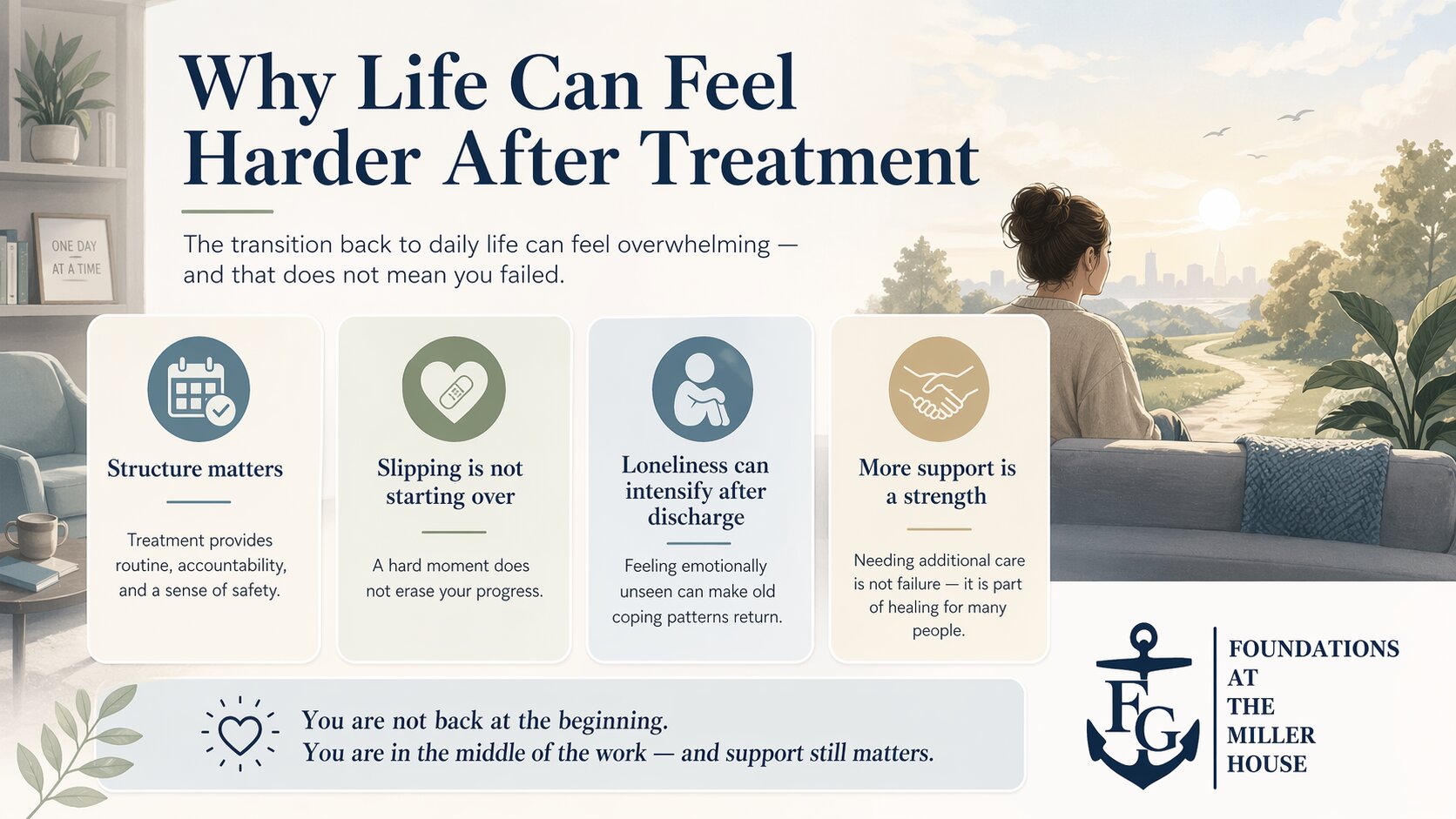
Slipping Doesn’t Mean You’re Back at the Beginning
This is the part that hurts the most for a lot of people.
You slip—even a little—and your brain jumps to:
“I ruined it.”
“I’m back where I started.”
“What was the point?”
But that’s not how this works.
You didn’t go backward.
You hit a moment you weren’t fully supported through.
There’s a difference.
Everything you learned is still there:
- The awareness
- The tools
- The ability to recognize what’s happening
Even if you didn’t use them perfectly.
Progress isn’t erased by one hard moment.
It’s tested by it.
This Is Actually Where the Real Work Begins
Treatment isn’t the finish line.
It’s more like a reset.
A place where you build the foundation.
But the real test—the real growth—happens outside of it.
In the messy, unpredictable parts of life:
- Conversations that don’t go how you planned
- Stress that hits out of nowhere
- Days where you don’t feel motivated
That’s where everything you learned gets applied.
And honestly?
That’s where most people realize they need more support—not less.
You’re Allowed to Need More Than One Round
There’s a belief that you should “get it right” the first time.
That if you go back, it means something didn’t work.
But that’s not how healing works.
Sometimes you need:
- More time
- More structure
- More repetition
- More space to actually integrate what you learned
Going back into something like residential mental health treatment isn’t a reset to zero.
It’s continuing the work from a place of experience.
You’re not starting over.
You’re starting smarter.
The Version of You From Treatment Is Still There
Even if you don’t feel like it right now.
Even if things have gotten messy again.
That version of you—the one who showed up, who tried, who learned—that doesn’t disappear.
It gets buried under stress, pressure, and real life.
But it’s still there.
And the fact that you’re reading this?
That you’re thinking about it again?
That’s proof.
You Don’t Have to White-Knuckle This Part
A lot of people try to push through this phase alone.
They think:
- “I should be able to handle this”
- “I don’t want to go back”
- “I don’t want to admit I’m struggling again”
But pushing through without support often leads right back to where you were.
Not because you’re weak.
Because you’re human.
Support isn’t something you “graduate” from.
It’s something you return to when you need it.
And there’s no shame in that.
There’s Still a Way Forward—From Right Here
Even if it feels like you’ve drifted.
Even if you’re not where you thought you’d be.
You’re not stuck.
You’re in the part no one talks about enough—the middle.
The messy, uncertain, figuring-it-out phase.
And that’s where real change happens.
Not perfectly. Not cleanly.
But honestly.
Frequently Asked Questions
Is it normal to struggle after finishing treatment?
Yes—much more than people talk about. The transition back to daily life is often the hardest part, even for those who did well during treatment.
Does slipping mean treatment didn’t work?
No. It usually means you hit a moment where your support didn’t match what you needed. The work you did still matters.
Why did I feel better in treatment than I do now?
Because the environment was designed to support you. Outside, you’re navigating the same challenges without that same level of structure and consistency.
Should I go back if I’m struggling again?
If things feel overwhelming or familiar patterns are returning, getting additional support can be a strong and proactive step—not a failure.
How do I know if I need more structure again?
If you’re feeling consistently overwhelmed, disconnected, or unable to apply what you learned, it may be a sign that more support could help stabilize things again.
Is it embarrassing to need more help?
It can feel that way—but needing support is part of the process for many people. It doesn’t take away from the work you’ve already done.
What if I don’t want to start over?
You’re not starting over. You’re continuing—with more insight, more awareness, and a clearer understanding of what you need.
If this part feels harder than you expected, you don’t have to stay stuck in it—or carry it alone.
Call (774) 252-6966 or visit our residential treatment program services in your area to explore what support could look like right now.